shipitfaststupid

No name or maker matches “”. Press Enter to search descriptions too.

Catalog / AI tools

0194Reddit posts

OOFmode: an ai tool for decoding corporate nonsense and emails

An AI tool for workers who need help decoding corporate nonsense and writing safer replies.

Problem it solvesCorporate politics and passive-aggressive emails make work feel draining.

Vishal_Kumar200 (@Vishal_Kumar200) built OOFmode for people dealing with toxic workplace communication. He reports it has been live since Sept 10 and has 0 users.

How they grewquiet launch; no Twitter following or big network

Visit ↗ reddit.combuilt in3 monthsso farsince Sept 10

Vishal_Kumar200

u/Vishal_Kumar200

I wrote 50,000 lines of code to survive my toxic manager. It's been live since Sept 10 with 0 users, here is my story and SaaS tool. Hey guys,A few months ago, I was completely drained by corporate politics, passive-aggressive emails, and useless meetings. Instead of quitting immediately, I channeled my frustration into VS Code.50,000+ lines of code later, I built OOFmode .It’s an AI-powered corporate survival kit.It has features like:BS Detector: Translates corporate nonsense into what they actually mean.Corporate Shield: Catches hidden manipulation in emails before you reply emotionally.Excuse/Rant Engines: Turns raw anger into HR-safe, polished professional messages.I launched it quietly on 10th September, but nobody knows about it yet (literal ghost town). I don’t have a Twitter following or a big network.I don't know if this is actually good or if I just lost my mind writing 50k LOC. Please check it out, use the free tier, and roast the hell out of it. Need your honest feedback.

Users

0

since Sept 10

Also filed under AI tools

  1. 0424

    Curie: an app that gets users logging in on Product Hunt

    So today I launched my first app on Product Hunt, complete success on one of the most competitive days to post!! Almost 90 upvotes and hundreds of users logged in. If you want to support me here is the link, any feedback is welcome!! producthunt.com/products/curie…

    @vimagoo_ · AI tools

  2. 0420

    MensorAI: an extension with organic traffic and installs

    I'd mostly given up on MensorAI. But my extension has 49 installs in the last 30 days, without any active promotion. It also still gets organic traffic through SEO/ GEO. But still $0 in revenue. There's no real incentive to buy. Biggest problems right now: A while ago I tried to reposition it, but stopped half way through and you notice that. There's a lot of conflicting wording. One last 4-week push: - refine the whole tool - a clearer workflow - simpler pricing

    @rouvenlue · AI tools

  3. 0399

    Tape Engine: an ai tool that helps rewrite prompts

    My faith is bigger than my fears. That’s why I’m still here. 9 months ago, on January 13th, I launched @Tapeengine. The first week, we got 6 paid users. By the second week, we crossed 7. Then the momentum slowed down. I tweaked the landing page copy. Nothing. I tried different approaches. Still nothing. So I pivoted. For the last several months, I’ve been building nonstop. In June, we launched the Tape Engine Android app on the Play Store. And somewhere along the way, I got tired of constantly rewriting prompts. So I spent a few days cooking up Savio AI. The first two days after launch, we got 23 installs. The last time I checked, it had reached 278 installs with 28 active users. But Tape Engine wasn’t the beginning. Before January, I had already been building CortexHub.studio. It was monetized with AdSense in February. And this month, I launched Bidriot.lol. And I’m still building. Nonstop. Behind all of these launches and numbers, there’s a part of the story people rarely see. The fear. The uncertainty. The nights when it was just me, my laptop, and my teary eyes staring at the ceiling of a hotel room, wondering if I was wasting my time. There were nights when the voice in my head told me: “Just give up. Get some rest.” But I couldn’t. I don’t just live for myself. I don’t have kids yet, but I have little nieces and nephews who look up to their uncle. And I made myself a promise: I would never become a bad example to them. My siblings were never a bad example to me. So I refuse to be one to them. I don’t know exactly where this road ends. I don’t know how many more pivots, failures, sleepless nights, or setbacks are waiting for me. But I know this: My faith is bigger than my fears. And I believe these struggles are a phase I have to walk through, not a place I’m meant to stay. Maybe this season isn’t here to break me. Maybe it’s here to build my character. So I’m still here. Still building. Still believing. Still going. Because I already know what will happen if I don’t try. Nothing. But I’m far more curious to see what happens if I keep trying. What happens if I keep building? What happens if I keep showing up? What happens if I refuse to give up? I don’t know the answer yet. And honestly, that’s exactly why I’m going to keep going.

    @Onlybenjamin_ · AI tools

  4. 0397

    ToneAdapt: an app that adapts tone for writing

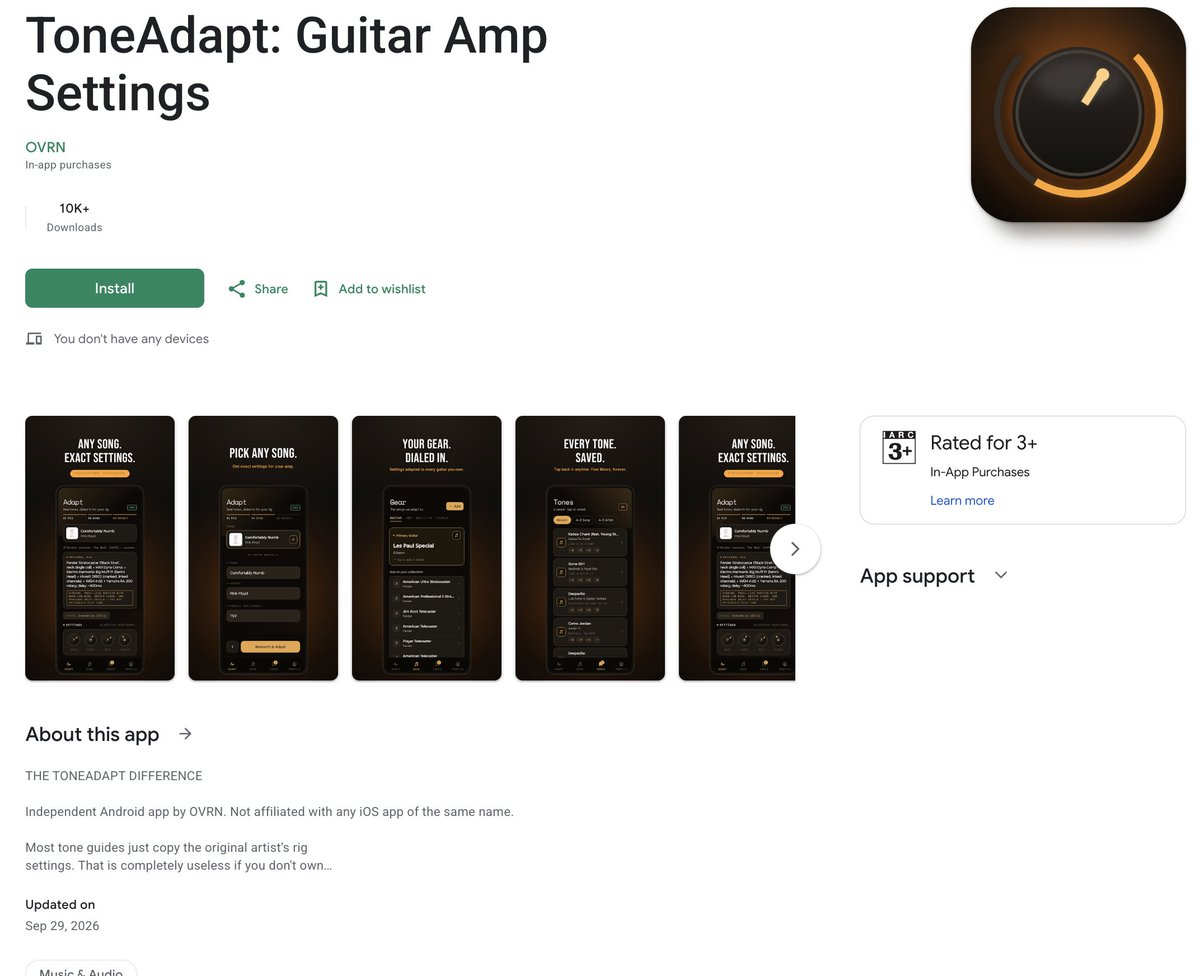
    I know whoever made this copycat of my app follows me / sees my content. 10K+ downloads off of my name. Revenue off of my name. I emailed you to just change the name, you refused. Reported you to google play store, we will see the outcome of that. I know & totally understand it's partly my fault for not having an Android version of my own app out sooner. But just know you had your chance. ToneAdapt (the legit version) is coming to the google play store this week. I haven't been this determined to see someone else fail in a long time.

    @kyanbuilds · AI tools

  5. 0390

    Bonsai 2: local ai coding that writes multi-file work

    this is what 12gb of vram builds in 2026, absolute magic > rtx 3060 12gb, #1 gpu on steam > bonsai 2 27b + mtp, 5.95 gb of weights > hermes agent, 5 hours, 328k tokens written > 8 js files, 2,368 lines, zero hand written code > 50 tok/s fresh, 22 tok/s average, 125k context watch the full video, 5 hours in 12 minutes of pure dance of a local ai model on rtx 3060 12gb vram, and stay till the end for the full gameplay. this entire game was built by bonsai2, a qwen 3.8 27b dense compressed to ternary, and this small model is punching way above its weight. it built multi file engineering work using hermes agent, sure it's not fast but perfect for overnights and routine work and the quality is insane, and context holding is another best one, it does not lose the thread. i ran PrismML bonsai 1 made from qwen 3.6 27b dense and i built things with it, but this time with the latest base model qwen 3.8 these results are insane, and because i loved building with it a lot i thought many more of you would run it because this gpu exists in almost every home. so i packaged mtp, doubled the speed from 26 tok/s to 50 tok/s, packed the prefill fix in and released it on huggingface, almost 4,000 downloads in 3 days. i'll leave a link below.

    @sudoingX · AI tools

  6. 0379

    CoLateral: a desktop app for structural engineering work

    I recommend you go ALL-IN on Opus 5.5. Over the past 62 days, I: • Built CoLateral, a full engineering desktop app • Built the website • Grew to 2,520 YouTube subscribers • Generated $3,000 in revenue I work in structural engineering. I'm not a software developer. But this is the part that matters most: If I lost all of it tomorrow, I'd still keep the most valuable thing. 62 days of documented experience building with the best tools in the world. Think about what that means in your next interview. The working world is about to start hiring people who can build with AI. Some companies already are. Get started slow. Just get started. More on my journey here: CoLateralai.com

    @nvandewetering · AI tools

  7. 0371

    EasyA: a community and app for learning crypto and ai

    In 2019, Dom and I started a company most people thought wouldn’t work. EasyA was always different. But for two brothers who’d just left their jobs to go all in, there was no going back. As we embark on our journey to go public, I thought you should know a bit more about why we started EasyA, the early days, and where we’re going next. Our story is about two brothers who refused to settle, and never betrayed the fire burning in their hearts. This is, of course, about you understanding what EasyA is. But it’s also about showing you that anything is possible. Just two brothers against the world. Our journey begins on a little island in the Atlantic, in an ancient city called London. Dom was born two years before me, and as the firstborn, he loved the attention. But much to the dismay of little Dom, I was on the way. And as someone who’s always been early to things, I decided to emerge from my mother’s womb two weeks ahead of schedule. So when I popped out to greet the world, Dom’s first words to my father were: “Mummy not nice”. Little did he know at the time that I’d be the best thing to happen to him! Early is something I’ve always excelled at. I was early to crypto in 2013, when I stumbled across the Bitcoin white paper and started mining it. Bitcoin was $100. XRP was $0.005. I was early to AI, when I built the first application to help blind people see. The two technologies fascinated me. As a teenager, I could barely contain my excitement at being able to play and contribute to such powerful technologies. Dom and I shared an immense passion for technology. We’d run speed tests on our computers, competing to see who could get theirs to run the fastest. And those competitions would later help me find the best clock speeds for mining crypto. I was obsessed with computers. While most kids my age were having fun saying three and four-letter words that can’t be written down here, I had my equivalents: CPU, PSU, GPU, FPGA, ASIC. My parents wondered what I was doing in the basement. They found me spending countless hours wiring things together, piecing together motherboards and finding spare parts wherever I could lay my hands on them. That year I took my first computer science course at Stanford University. It was a magical time. And around this time was also when I locked in. I embarked upon what would become a more than decade-long monk mode. A marshmallow test on steroids. And it started working. I won a place to study at Cambridge University. A university that laid the groundwork for modern science: where Newton formulated the laws of gravity, and Alan Turing gave birth to computer science and AI. At Cambridge I locked in again. Every scholarship was within reach. And each one fell into my hands, one by one. Triple first: the best scholar my professors had ever seen. What did it feel like? I was filled with immeasurable happiness. But at the same time immense pain: the price to pay for attaining greatness. Dom won his scholarships at the University of Pennsylvania, and the Wharton School. He breathed the same air as Elon Musk, Donald Trump and Warren Buffett. Both of us won prized jobs at the best New York firms in the world: Goldman Sachs, Blackstone, Sullivan & Cromwell. But something wasn’t right. How could we have the greatest impact possible on humanity? The answer certainly wasn’t by sitting in a cubicle in a concrete cage. So we left our jobs. We threw everything away and started EasyA. From big, fat New York salaries, down to annual earnings of precisely $0. We moved back in with our parents (and I am forever grateful to them for feeding us over those difficult months when nothing seemed to work). We coded EasyA in our childhood bedrooms. And when our eyes became blurry, we hopped on our bicycles and started flyering to get the word out. We were working harder than we’d ever done. And yet nothing worked. But we didn’t give up. We kept shipping updates to the EasyA app. Day in, day out. Most apps ship updates once every week or two weeks. We shipped multiple times per day. And we got out there. We started networking, meeting the people who’d need EasyA. And little by little, day by day, night by night, things slowly started coming together. The first $10, the first $1,000, the first $10,000. The first $100,000, then the first $1,000,000. Dom and I have never forgotten how hard it was when we first started out. Our ambition is bigger than it’s ever been before. In our lab we’re working on technologies which, if we’re successful, will fundamentally change humanity for the best. For most companies going public today, the listing is an exit. It’s a time when investors get their money back after years being trapped. Dom and I never raised money from external investors. Today, we still own 100% of EasyA. We didn’t need to go public. Staying private is far easier. But community is everything for us. We’ve reached an inflection point in EasyA’s trajectory. We're building things within our lab that we believe will bring a step change in humanity. And we want to bring our community and users along with us on this journey. We couldn’t have done it without you, and we won’t do it without you. We’re firmly in research and development mode. We’re going to take big swings at some of the biggest problems in the world. Many of those swings will fail, just like most of the app updates we shipped when we first started failed. But just like when we first started, we won’t ever give up. Every swing we take compounds. And just like a champion boxer who never gives up, we'll keep fighting until we win. AI and blockchain are two of the most important technologies in the history of humanity. Our ambition is to lead the world in both of them, and we’re going on this journey together with you. we're making it happen.

    @kwok_phil · AI tools

  8. 0360

    Humming: a vllm kernel library for running glm-5.3-flash on sparks

    Humming season has begun! Marlin has run 4-bit inference for years. This week my uncensored GLM-5.3-Flash on four DGX Sparks moved its experts off it. They now run on Humming, the new kernel library inside vLLM, which added support for the Spark's chip six days ago. As far as I can find, this is the first public GLM-5.3-Flash build on it. None of it exists without these people. Z.ai (@Zai_org) open sourced GLM-5.3-Flash. Blackfrost (@Blackfrost_AI) made it uncensored. Z Lab (@zhijianliu_) created DFlash, and incoai trained the DFlash2 drafter that makes this model fast (huggingface.co/incoai/GLM-5.3…). Tony (@2WildTech) got it running on four Sparks first. Eight of my patches are ports of his GB10 work, and both FlashInfer fixes are his. Jacopo Nardiello (@jnardiello) proved the 8-bit drafter on his own Spark build. My port of it made agent sessions 8.6% faster. Jinzhen Lin and Julian Huang at Ant Group built Humming, with @mgoin_ among its contributors (github.com/vllm-project/h…). The @vllm_project team makes the engine under all of it, and LLM Compressor, the tool I quantized with. FlashInfer runs the attention. Matt Mastracci (@mmastrac) and Jared Wen fixed three bugs that broke how this model reads anything past 2,048 tokens. Juntian Liu, weijie and Harshil wrote the other vLLM fixes I carry. Stanislav Bardyuk wrote the NCCL fix for the network deadlock I reported, and Rami Nudelman at NVIDIA brought it to me. Onur Solmaz (@onusoz) wrote oomwrap, which guards every launch. Here is what I added. I quantized the whole model myself. 643 GB of Blackfrost's full-precision weights, down to 4-bit on my own four Sparks, with a scale search I picked after testing the options on real weights. It has 2% lower error than the conversion I shipped three days ago, and the same agent tasks finish 20% sooner because fewer answers run out of room. Four of the 18 patches in the build are mine, two of them ports of Jacopo's experiments. So is every build script, launcher and benchmark in the repo. Resumed agent sessions now keep their cache instead of recomputing it, so the first token comes about a third sooner on long sessions. And the model always thinks at max, the way my agents use it. I also wrote short-turn caching into vLLM's cache manager, with upstream fixes from Netanel Haber and Nick Hill. Short agent turns went from 0% to 59% cache hits. It failed one correctness check I set before the run, so it waits. Three days ago my build ran on Tony's conversion recipe and the vLLM 0.30 release. Today it runs my own quantization on vLLM's development branch and its newest kernels. I learned a ton getting here. The newer path costs about 7% throughput on long agent sessions against my 0.30 build. I took that trade. Fixes land on main first, and Humming is young, with room to grow. Want to try it? With four Sparks, the README takes you from a stock vLLM image to a running server: one build script and one launch command per node. The build checks every patched file byte for byte against the image I serve. One user gets 38 to 128 tok/s depending on what it writes. 32 users get 572 tok/s together. Uncensored, always reasoning. *Open doors* Where vLLM main loses 5% against 0.30. I have not profiled it yet. The drift that keeps short-turn caching out: one resume in eight. Noise or bug. Repo: github.com/joesinvestment…

    @JoesInvestments · AI tools