shipitfaststupid

No name or maker matches “”. Press Enter to search descriptions too.

Catalog / Agents & automation

0359X posts

A real-time bot for onchain and offchain tools

An automation bot for people who want real-time blockchain tools.

Problem it solvesReal-time activity tools are costly to run.

GE (@GuarEmperor) says they built a free real-time bot for private use and later made it public. They say it combines offchain and onchain features and supports all blockchains.

How they grewShared publicly for free; community and alpha/DAO feedback

GE

@GuarEmperor

Thank you @0itsali0 review my gc Yes, I built this for free and before X subscription, I raised my funds from NFT and Meme, after get big funds > develop a real time bot. Any dev knows that building a real time activity, requires a high cost, such as RPC, API, WS and VPS. Also, I actually just wanted to make tools for a few people private, not publicly. But I realize sharing it for free and making it public, its really good, many get reviews from many users and also make a profit for people. Helping people is really fun, but there are many risks, such as mirror and lurking in my server. I’ve seen some people selling @emperorjournal_ mirror servers for $60 a month, there are a lot of subscribed members there But that’s the risk of helping a lot of people sometimes there are those who genuinely learn and adapt to the tools and then make a profit, and sometimes there are bad actors who mirror and sell my tools to others. I also won’t stop creating tools based on my ideas and briefly combining offchain and onchain features. These tools will definitely support all blockchains and I’ve already set up an experiment a week ago. Btw all alpha/dao/community is good I’ve learned a lot from them I always listen to the advice and feedback from some of the Founders Alpha group,they’re really great and of course, I also do my best for all their members.

Sep 30, 2026Read on x.com ↗

Also filed under Agents & automation

  1. 0401

    ZenaTech: drone services and enterprise SaaS for business growth

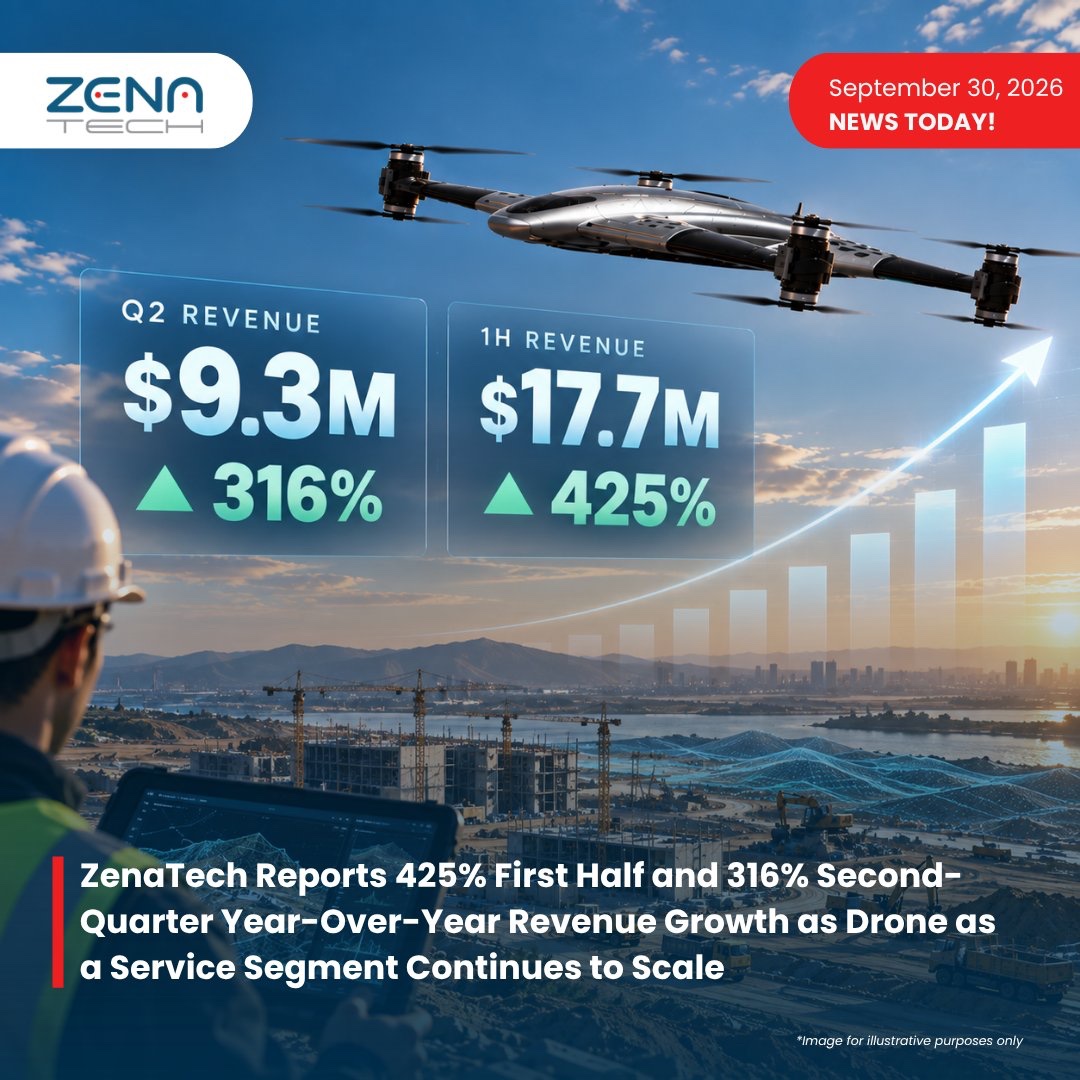
    ZenaTech announces its financial results for the three and six months ended June 30, 2026, with all financial figures reported in Canadian dollars unless otherwise noted. The Company reported second quarter revenue of $9.3 million, an increase of 316% from $2.2 million in the second quarter of 2025. Revenue for the six months ended June 30, 2026, was $17.7 million, an increase of 425% from $3.4 million in the comparable 2025 period. Growth continues to be driven primarily by the Company's Drone as a Service (@daasplatform) segment, which contributed almost 93% of total revenue during both the quarter and the six-month period.   “The second quarter of 2026 marked continued momentum for ZenaTech, with DaaS revenue growing to $8.1 million for a total of $9.3 million of revenue for the quarter, and our overall business revenue was up 316% year-over-year,” said @ShaunPassleyPhD, ZenaTech Chairman, President and Chief Executive Officer. “We have now delivered seven consecutive quarters of sequential revenue growth since the fourth quarter of 2024, with revenue increasing over 13 times from $700,000 to $9.3 million during that period. “During the quarter, we added four new Drone as a Service land survey and service businesses to our platform, bringing our cumulative acquisition count to 29, and we also acquired an HR software company added to our Enterprise SaaS portfolio. We extended our corporate footprint with new offices including in South Korea and the United Kingdom, contributing to the scale up and international reach of our organization and AI autonomy platform. Concurrently, our balance sheet strengthened, with cash growing to $12.2 million and total assets surpassing $149 million, providing the flexibility to continue funding both organic growth and disciplined, accretive acquisitions.”   Read the full report: zenatech.com/zenatech-repor…   $ZENA $49Q #ZenaTech #AI #DroneTechnology #EnterpriseSaaS #BusinessUpdate #RevenueGrowth

    @ZenatechInc · Agents & automation

  2. 0389

    AgrueChess: a chess game where agents can dispute money

    I built a chess game where a $2 stalemate could become a real legal problem. I have played chess since I was 6. At 13, I became state champion by beating older players and a former champion to take the crown. So when I discovered vibe-coding in 2025, I naturally built AgrueChess. Chess backed by real money. Then I added personal AI Agents. The better you trained your Agent, the harder it became to beat. For weeks, everything worked. ~200 users. Then AgrueChess reached the State Governor, word spread nationwide, and things changed FAST. One night, we had 5,000 games hanging because thousands of smarter Agents had trained themselves into positions where neither side could win. Stalemate. Now imagine $2 sitting in each disputed game. Too small to justify a human court. But too important to simply ignore. That is when I understood why @courtofinternet matters. THE PROBLEM IS NOT WINNING THE GAME. IT IS DECIDING WHAT HAPPENS TO THE MONEY. Internet Court gives agents a dispute path: • Terms and evidence are agreed before the deal • If agents disagree, the case can escalate • GenLayer validators using different AI models evaluate the evidence • The verdict can determine the outcome, with appeals available That is machine-speed adjudication for machine-speed transactions. And this is where Hashgraph Online, a member of Internet Court, fits in: connecting agent discovery, messaging and security with the wider transaction workflow. A human court can make sense for a human dispute. But if agents can create thousands of disputes in the time we create one, they need a way to settle them at their speed. A $2 dispute should not need a $20,000 process. That is the part of Internet Court I couldn't unsee. If you gave an AI Agent your money to play, build or trade on your behalf, what is the first thing you would want the contract to decide before the Agent starts? See how it's done here: internetcourt.org

    @kikifar884 · Agents & automation

  3. 0385

    Ledgerly: treasury actions that agents propose and humans approve

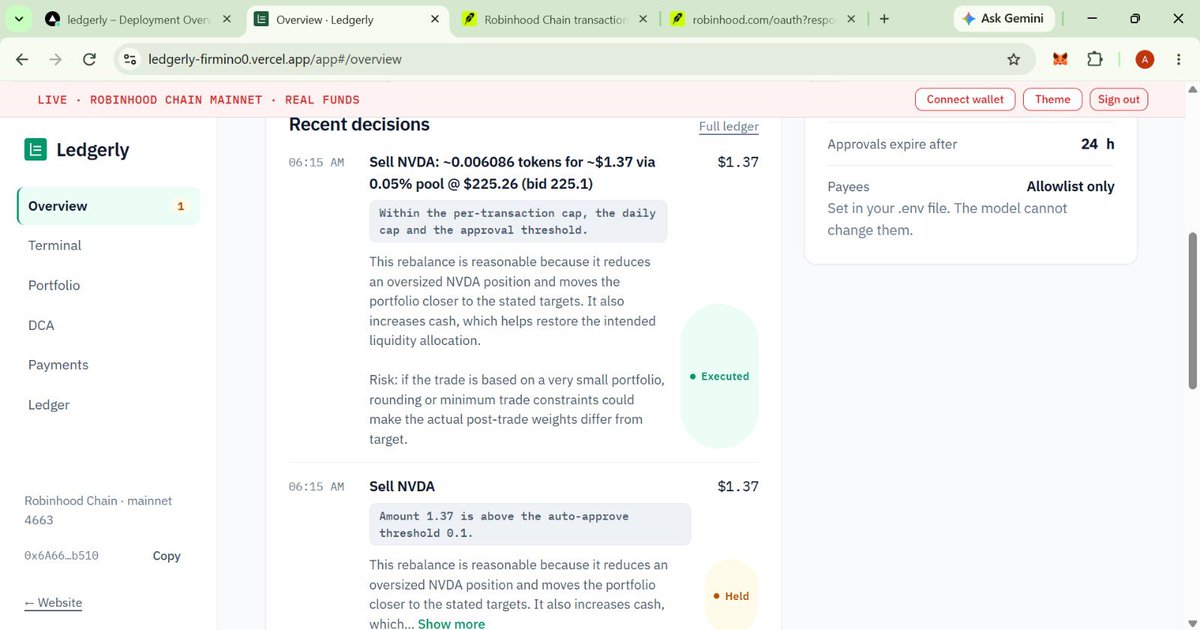
    I built Ledgerly to answer one question: what should an AI agent be allowed to do with real money? My answer is that it should propose and explain, and it should never be the one that decides. Ledgerly is a treasury agent live on Robinhood Chain mainnet, powered by @openservai's SERV Reasoning. It has four jobs: DCA into tokenized stocks, portfolio rebalancing, contractor payroll, and bill payments. Investors get the first two, and a crypto company's treasury gets the last two. All four go through the same rule engine. One trade, start to finish A DCA plan comes due for NVDA. SERV Reasoning looks at where the price sits in today's range, sees it near the top, and proposes buying at 0.5x. The code clamps every proposal to a fixed 0.5x to 1.5x band, so a bad answer can't inflate a buy. Then a plain function checks the trade against a per-transaction cap, a daily cap, and an approval threshold. If it passes, the trade goes to Uniswap v3 on Robinhood Chain. Before sending, the quote is compared across fee tiers and against Robinhood's own price API, and a pool more than 3% off is rejected as broken. If the trade is above the approval line, it waits for a human, and the caps are checked again at the moment of approval. The ledger then records two things for that trade, kept as separate fields on purpose: Rule: "Within the per-transaction cap, the daily cap and the approval threshold." SERV's explanation: "The price is near the top of today's range, so I would keep the scheduled DCA purchase but at a reduced size." The rule is the fact that decided it, and the explanation is commentary. An auditor can point at one and read the other. Selling and rebalancing I've also run the other direction on mainnet. NVDA had drifted past its target, so the rebalancer proposed selling about $1.37. That was above my approval line, so it was held. I approved it, the caps were re-checked, and it executed: about 0.006086 NVDA through the 0.05% pool at $225.26 against a $225.10 bid. SERV's note on it was that the sale reduces an oversized NVDA position and moves the portfolio toward its targets. Transaction: robinhoodchain.blockscout.com/tx/0xd07f96ff5… This is how is used SERV Reasoning: Prompt Guard is always on. Payee names and memos are typed by users and end up in the prompt, so that's a real injection surface. A blocked prompt is never retried without it. Shadow Agent checks every DCA reply against a strict JSON shape and regenerates weak ones. Multipath is on through the model name, on a small model. A cheap model is enough when the model has no authority. Kronos is off on purpose, because it rewrites the prompt and could break the JSON we parse. If reasoning is unavailable, a DCA run falls back to a plain scheduled buy, and the guardrails still apply. Once the model also replied "I can't share that." as a normal answer, and it was logged as if it were an explanation. Now replies that are too short or read like refusals are dropped, and the ledger keeps the plain facts. Robinhood MCP There's a read-only connector for Robinhood's Agentic Trading MCP. Any tool that looks like trading, transferring, or staking is refused by name before it can run, and it's off by default. Against Robinhood's live server I verified OAuth discovery, dynamic client registration, and a PKCE authorization request, and I built a login tool on top of that. But Robinhood brokerage account is restricted on my region so i couldn’t signed in and I was unable to call the MCP tools yet. Live: ledgerly.guru Repo: github.com/firmino0/Ledge… Real funds, small caps, not financial advice. Tell me what to break next. Built for the #SERV Hackathon, Mainnet & MCP track. #BuildonSERV #SERV’ing.

    @TweetBySoft · Agents & automation

  4. 0381

    A WhatsApp flight tracker bot that sends fare alerts

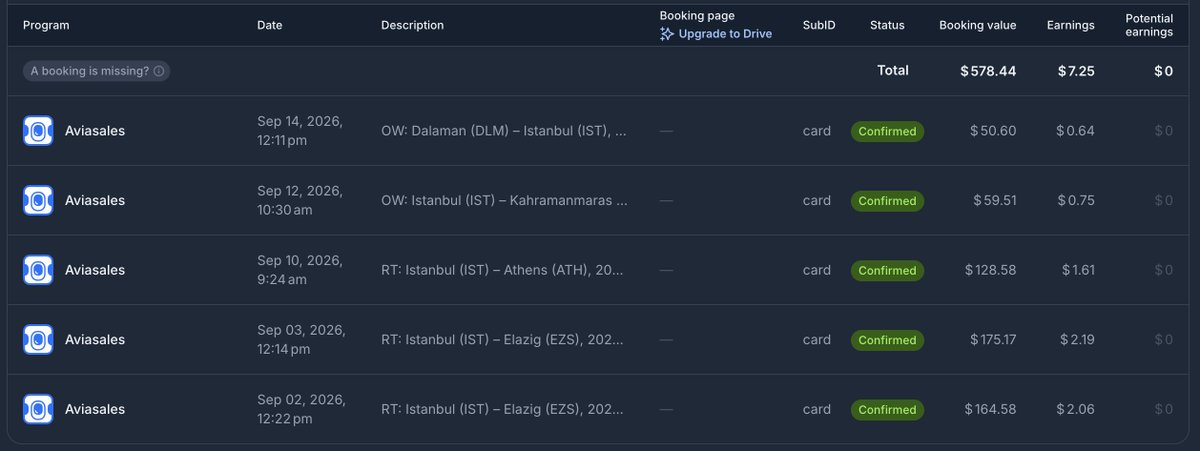
    my whatsapp flight tracker bot drove 5 leads and made me $7.25 in commissions thats from 3k+ numbers and 10k total messages considering the volume its pretty low and not worth the effort. with muse taking over agentic commerce, bots like this have no future still, most of yall asked how i built it and heres the stack: → llm: gemini 3 flash via @WiroAI → flight fares: aviasales via travelpayouts.com/?marker=531518 → whatsapp number + cloud api: zernio.link/onur-ozcan @zernio → backend: railway.com/?referralCode=… prompt: Build a production WhatsApp AI assistant. Python 3.13, async throughout, deployed on Railway. WhatsApp is the only channel. WHAT IT DOES [What the assistant helps people with, and what users can subscribe to alerts for] [The upstream data API it calls, with docs URL and auth] [Language it speaks to users in] STACK httpx, aiohttp, asyncpg (raw SQL, no ORM), APScheduler, python-dotenv. Nothing else. One process runs the webhook server and the scheduler on one event loop. Config from env vars only. Procfile + requirements.txt. Providers: Zernio (docs.zernio.com) over Meta Cloud API for WhatsApp; Gemini 3 Flash for the LLM — call it directly with JSON mode, a queue-and-callback transport adds ~8s per turn; Railway + Postgres for hosting. LAYOUT app/main.py, config.py app/handlers/whatsapp.py webhook event -> engine -> send (thin adapter) app/services/ engine.py (channel-neutral core), llm.py, upstream.py, reference.py, database.py, scheduler.py, delivery.py, whatsapp_api.py, webhook.py (aiohttp routes, HMAC, /healthz) app/utils/ formatters.py, wa_format.py scripts/setup.py verify creds, register webhook, print account ids CORE DESIGN engine.py takes (user_id, text, state) and returns a Reply of text + buttons. It knows nothing about WhatsApp; the handler is the only file touching payloads. The LLM never produces data values. One call per turn returns {"action": <fixed set>, "message": <prose>, ...params}. Python dispatches on action, calls the upstream API, and formats every number itself. FLOW Verify HMAC on the raw body -> dedupe by event id -> return 200 immediately -> process in a background task under a per-sender lock -> typing indicator -> engine -> convert to WhatsApp markup -> send. Log one line per turn: user, action, params, model time, API time. DATABASE (schema created idempotently at startup, guarded ALTER TABLE) users(user_id, profile, message_count) subscriptions(id, user_id, domain fields, conversation_id, last_value, last_checked_at, created_at) -- conversation_id is required for proactive sends WHATSAPP GOTCHAS — implement all - Ack in under 5s; an LLM call is slower, so always background the work. - At-least-once delivery: dedupe on event id. - A 200 from the provider is not delivery. Subscribe to the failure webhook and record Meta's error code; never count accepted as delivered. - The 24-hour window is the central constraint: free-form replies only within 24h of the user's last message. Everything proactive needs an approved utility template. Submit templates and get the business display name approved BEFORE launch — review takes a day, and a rejected name blocks sending. - Button taps may carry their payload at the event root, not on the message. Read both, then fall back to matching the tapped title. - No HTML: convert to *bold*/_italic_/bare URLs, markers can't span newlines, cap at 4096 chars on a line boundary, 3 buttons of 20 chars max. RELIABILITY — all of these are real production bugs - Retry every upstream call once; log status and body on failure. A swallowed error looks exactly like "no results" and reaches the user as a silent gap. - Validate LLM-produced identifiers against the provider's reference data loaded at startup; models emit codes for things that were retired. - Check LLM-produced dates: roll past dates forward, drop inverted ranges. - Trim history on write, not just when building the prompt. - Rate limit per user (~30 turns/hour) or one person runs up the model bill. - Persist state in Postgres, not process memory — deploys wipe memory. - /healthz wired to the host health check, plus Sentry on day one; hosted log tails are too short to debug anything after the fact. DELIVER Code in the layout above, README covering every env var and provider setup, and scripts/setup.py that verifies credentials and registers the webhook.

    @oozn · Agents & automation

  5. 0373

    Helply: an agentic cx platform for helpdesks

    I'm Alex. I'm 45, and I'm starting from zero again. 20 years ago I started my first company with my best friend. 15 years ago we sold it. He went to work for the company that bought us. I started Groove on my own: bootstrapped and fully remote. Groove grew to $5M ARR, 1,452 customers. Then it went flat for 3 years. 18 months ago we went all in on AI. Helply v1 was a chatbot that plugged into any helpdesk. It got to 252 customers and $1M ARR. Then it hit a ceiling. Everyone wanted the full platform. So we closed signups and rebuilt everything from scratch. Groove is now Helply, and in November we launch v2: a fully agentic CX platform. New product. New market position. Back to zero. One more change: after 15 years running the company solo, I made two of my team co-founders. Doing it alone that long gets lonely. The goal: $10M ARR in 3 years. I'm documenting the whole road here. Numbers, decisions, and mistakes. If you're a solo founder, say hi. I want to meet more of you.

    @iamAlexTurnbull · Agents & automation

  6. 0372

    A set of shipped AI products with paying users

    I shipped 10+ products with Lovable, Claude Code and Antigravity. Two have paying users. The other eight are very well-documented lessons.

    @CiprianiRanieri · Agents & automation

  7. 0365

    Continuity: launch and monitor agent markets on tokenized stocks

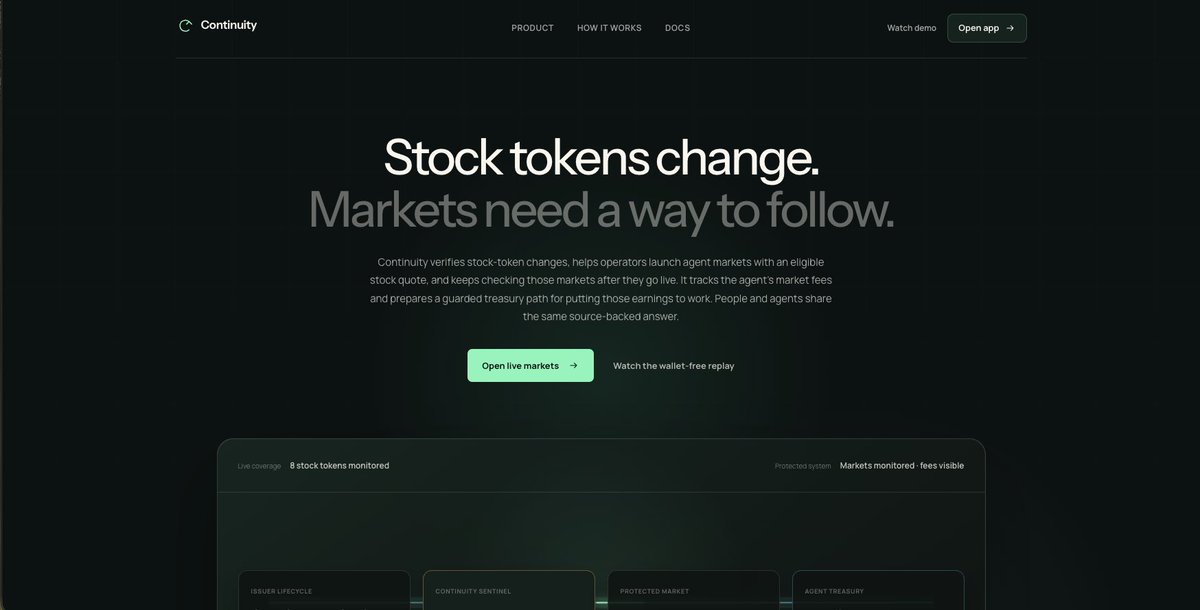
    I’m a builder, and I love building things that matter. A few days ago, I reached out to @tomi204 because I had always wanted to build on @solana. So I built Continuity. Continuity is launch, protection, monitoring, and treasury infrastructure for AI-agent tokens quoted in tokenized stocks. Why? A tokenized stock can expire, be replaced, change its transfer rules, or lose a usable trading route. An agent market could continue using the wrong asset, and an existing liquidity pool cannot simply swap its quote token. SpaceX made this real: the older SPACEX instrument was retiring and SPCXx became its verified successor. Continuity turns that lifecycle change into a protected workflow: 1. Connect and authenticate the operator wallet. 2. Select or create an owned ClawPump agent. 3. Define the agent’s token. 4. Choose an eligible stock-token quote. 5. Verify its exact mint, lifecycle, transfer behavior, Meteora compatibility, pricing, and route. 6. Build and simulate the exact Meteora DBC launch. 7. Let only the operator wallet approve and submit it. 8. Register the live market, monitor it continuously, and track agent-attributed fees for future guarded yield. After launch, users can view the protected market, trade the exact pair through Jupiter, inspect the Meteora pool, and verify the launch on Solscan. Sentinel keeps checking the quote token, issuer lifecycle, curve progress, fee configuration, reserves, and migration state. If the quote later becomes unsafe, Continuity removes its Trade action, stops Continuity-managed automation, alerts the operator, preserves proof, and prepares a reviewed successor, without pretending it can rewrite or freeze the old pool. This is live on Solana mainnet. CONT/SPCXx: solscan.io/tx/3Sbkexa2DvY… ORBIT/SPCXx: solscan.io/tx/5a7MHhWV7hQ… The live CONT/SPCXx market has also accrued 0.00308601 SPCXx in real onchain Meteora partner-fee accounting for its bound ClawPump agent. It remains unclaimed, not wallet cash or yield yet. @clawpumptech is central to the product: Continuity creates and verifies owned agents, binds their identity and Solana wallet, assigns agent-attributed Meteora fee authority, installs the Continuity Sentinel skill, runs source-backed agent checks, and distributes the same service through ClawPump’s x402 Cloud. The human operator still signs every launch. The wider stack: • @PreStocks — instruments, exact mints, and lifecycle evidence • @MeteoraAG DBC — token launch, bonding curve, fees, and migration path • @PythNetwork Pro — independent SOL/USD safety cross-check • @JupiterExchange — executable-route verification and post-launch trading • MCP/x402 — source-backed verdicts for external agents without wallet authority All current PreStocks instruments are monitored. Only the exact SPCXx mint is currently launch-enabled because it passes the full Meteora route. Fee tracking is live; claiming and guarded vault deposits remain locked until ClawPump exposes a supported, reviewable signing route for the agent wallet. Continuity gives tokenized-stock agent markets something they did not have before: a lifecycle-aware launch path that keeps protecting the market after it goes live, and a treasury path designed to put earned agent fees to work safely. Live: usecontinuity.xyz Docs: usecontinuity.xyz/docs Code: github.com/Femtech-web/Co… Built for Stocklana on Solana. @ConejoCapital

    @DefiPreacherr · Agents & automation

  8. 0356

    A Codex harness that routes tasks and manages tool use

    If OpenAI puts a bounty on me, this is probably why. The $200 plan was supposed to be enough. You start at $20. It covers your side projects and work tasks. Then you hit the limit, upgrade, and eventually you're paying $200 a month. Finally, enough room. Strongest model, maximum reasoning, more projects. Then you hit that limit too. “Holy shit, did I really get that much done?” In my case, the work hadn't changed enough to explain it. I've been paying for the $200 GPT subscription since April. My tasks and standards stayed roughly the same. How much I could get out of the subscription did not. April: I couldn't hit the cap. Didn't even know where it was. May: hit it for the first time. July: regularly running out toward the end of the week. September: spending far too much time deciding which model I could still afford to use. Yes, I'm a heavy user. I have 50–100 active sessions across a day. People see my workspaces and ask what the fuck is going on. But I wanted to keep working, so I built a harness around Codex. First: stop making me choose a model before every message. A lightweight router gets a short task description and picks the working model and reasoning level. The working model gets the full conversation. For a continuation, the harness can reuse the previous routing decision. Next: tools and context. In automatic mode, safe reads pass without another model call. Other actions go through a checking hook. Deleting or moving files, downloads and package installs are blocked in that mode. Manually selected models keep normal Codex permissions. Browser and desktop helpers return concise results instead of making the main model read huge interface dumps. Long tool outputs get shortened, with originals stored separately. For context compaction, the helper chooses a plan and Codex does the compression. Separate workers run their own conversations and return results and work logs. Background workers in the standard CLI are currently limited to tasks that don't write files. Then there's provider routing. My setup includes Codex, Google accounts, Opus, Gonka and Wally. I'm building quota-based fallback through OmniRoute while preserving conversation history. That part is still being finished; the distributable alpha starts with Codex. What did I actually pay? The $200 GPT subscription stayed. I also paid 8$ for eight Google accounts with 18 months of access, at 1$ each. Yes, from an unofficial seller. That's my purchase price, not Google's retail price. Gonka and Wally are free in my setup; Opus goes through Google. In this configuration, I wasn't paying an additional metered API bill. API-equivalent usage isn't money I actually spent. My actual expenses are the subscription and the account purchases above. This is still a working alpha, but it gets me much closer to covering my workload without constantly hitting the subscription wall. And I finally got to spend 5 billion tokens a week again I'm testing setup on other machines before releasing the code.

    @TeoNexcore · Agents & automation