shipitfaststupid

No name or maker matches “”. Press Enter to search descriptions too.

Catalog / Sales & outreach

0388X posts

Warm outbound engine: linkedin outreach that sends personalized assets

An outbound system that finds warm leads on LinkedIn and sends them useful assets.

Problem it solvesCold lists are cold on arrival, so reply rates stay low.

Jáen (@speedrunjaen) packaged a LinkedIn outbound system into a skill for any harness. It targets buyers who already reacted to relevant posts, builds a personalized asset for each lead, and reports 55% reply rates plus hundreds of signups on autopilot.

How they grewLinkedIn posts, reactions and comments; Heyreach for LinkedIn; email

Jáen

@speedrunjaen

The agents that run my LinkedIn outreach are currently getting a 55% reply rate on cold outreach and are generating hundreds of signups for me completely on autopilot. I packaged the exact system into a skill that works for any harness so you can copy it for yourself. superagnt.com/skills/warm-ou… Heres why this system prints qualified replies: most outbound starts with a list out of apollo, zoominfo or clay. firmographics. who could buy. that list is cold on arrival because "could buy" and "is thinking about this right now" are two different lists. so mine starts from linkedin posts my buyers are already reacting to. that also means every person on the list actually uses linkedin, since they just reacted to a post on it. most people don't, so a message to a normal list mostly sits unread. across the client accounts i've worked on, an apollo-style list usually gets about 1/10th the reply rate of one built this way. the posts come from three places: buyers posting about the problem themselves (hiring for it, breaking under it, shopping for a fix), a watchlist of my competitors and the creators my buyers follow, and the topic itself. when a buyer writes the post, the author is the best lead on it. anyone reacting to a competitor's product post is already shopping. every search is written in the words buyers actually post in, because vendor jargon only finds other vendors. it pulls everyone who reacted or commented, drops anyone i've already contacted plus competitors and their staff, and scores each person 0 to 100 against my ICP with the reason written on the row. anyone under the bar is gone before i've paid for their email. this is the part everyone skips. for every lead that clears the bar, it reads their website, their LinkedIn profile & anything else it can find about them on the internet, works out what agent would actually help their operation, and builds it. a real one, sitting there, with a claim link. so i am not sending "quick question about your outbound." i am sending "i built you an agent that does X for your company, want me to send over the link?" it sequences that into heyreach for linkedin and instantly for email, then runs the inbox. anyone who has done outbound knows reply speed is most of the game, and also the exact thing you quit doing by week three. every reply fires a webhook. it re-reads the whole thread, tags it interested, not interested or auto-reply, pings me in slack the second someone's interested, and sends them their claim link. i don't touch it. and every reply feeds the next run. it writes more searches like the ones that got answers, so week four sources better than week one. the general rule, and it has nothing to do with my software: use AI to build a personalized, genuinely useful asset and give it away in the first message. you're not hard selling anyone. you are handing them a thing. and because it's built off their actual company, nobody can mistake it for a template. reply rates go up for both reasons at once. it doesn't have to be an agent. the skill builds whatever your business is already good at making: - sell lead gen? a sample list of 10 to 25 of their own buyers - sell SEO? the 3 to 5 searches their competitors win and they don't - build websites? a teardown of their homepage with three fixes - consult? a one-page plan for the exact problem they commented about the playbook behind the messages is the best outbound advice on the internet in one place. it's built from 25 full-length videos and 60 posts from operators who do this at scale, plus 3 production systems running this exact play. scraped the videos and posts with superagnt's data MCP btw. run it once in claude code or codex and look at what it staged. once you like it, it turns the whole thing into a small agent team on a schedule. the sourcing side runs about 8 cents per qualified lead in production. grab it here, paste the install prompt into your agent and let it cook: superagnt.com/skills/warm-ou…

Reply rate

55%

cold outreach
Sep 30, 2026Read on x.com ↗

Also filed under Sales & outreach

  1. 0391

    A PRM that manages partner sourcing, onboarding, and commissions

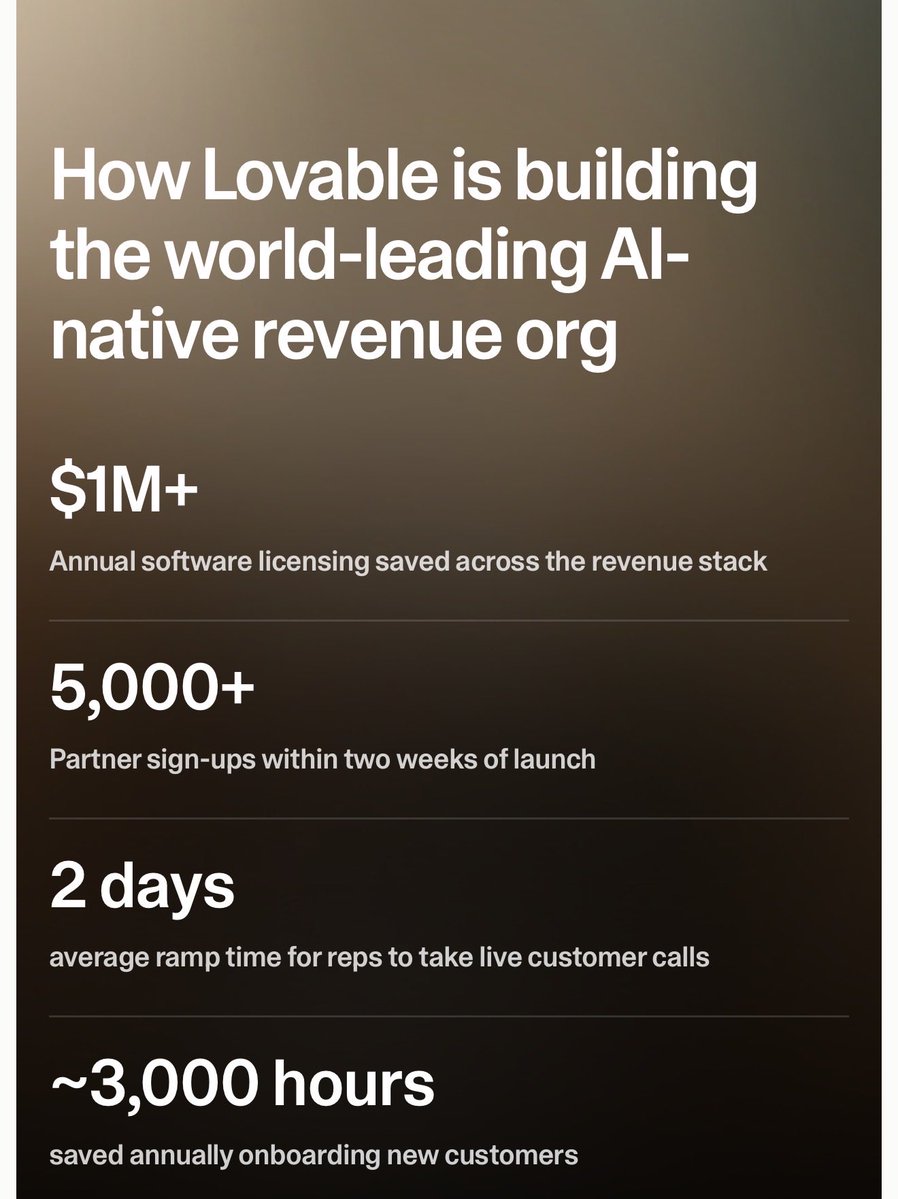
    our revenue team saves over $1M a year in software licenses by building our own tools in Lovable instead of buying them. The PRM is one I built. when we launched the partner program, 5,000+ partners signed up in two weeks. That PRM now runs the whole program, from sourcing and onboarding to certifications, lead routing and commissions, for thousands of partner users across 100+ countries. leads route to the right partner manager by geography. Certifications grade themselves. Commissions accrue straight from Stripe. It syncs with our CRM, has a Slack agent on top, and has been load-tested and security-audited like any production system. and it's not just partners. The team has also built our rep training, pipeline, deal desk and customer onboarding apps. Deal approvals went from days to minutes, new reps take live calls within two days, and onboarding alone saves around 3,000 hours a year. Read more about it here: lovable.dev/customers/lova…

    @TheTekAnalyst · Sales & outreach

  2. 0375

    SyncGTM: gtM software for small b2b teams

    @syncgtm just crossed 3,500 users 🎉 What surprises most customers is that this entire product has been built and maintained by just 2 engineers and me. I’m super proud of how much our tiny team has shipped. But building my first tech startup this way also taught me some painful lessons. Here's how I would build differently if I was to rebuild again: 1. Don’t bootstrap a startup that actually requires funding: Before deciding to bootstrap, estimate what the company will realistically need in engineering, distribution, infrastructure, and time. Some businesses are great to bootstrap, others become unnecessarily hard because you’re under-resourced from day one. 2. Solve one problem extremely well before expanding: We tried to solve too many adjacent GTM problems too early. Every extra use case added more complexity, more positioning problems, and more things for a tiny team to maintain. If I started again, I’d narrow the wedge much more aggressively. Become the obvious product for one painful problem first, then expand. 3. Don’t copy a mature product. One mistake I made was trying to copy Clay and too many of its features instead of fundamentally solving our users’ core problem. That led us toward a much more complex product than we needed. Activating complex product requires a solid GTM system. We haven’t reached the activation and revenue levels we should have partly because the platform became too hard for new users to understand quickly. Simpler would have been better. 4. Your GTM needs to match the product. A complex product with a learning curve cannot use the same GTM motion as a simple self-serve SaaS tool. For us, demos, founder-led content, templates, and showing real workflows matter much more than just driving traffic. 5. Learn how to orchestrate with Claude Code 🤖 Almost everything behind the scenes at SyncGTM now uses Claude Code or ChatGPT somewhere in the workflow. Back office ops, lead sourcing, outbound, SEO, website work, and internal tools are heavily AI assisted. That setup lets a tiny team operate like a much larger company. We now get around 9K to 10K organic visits a month and rank for high-intent keywords with a team that could never have done this two years ago. Startups can now run parts of engineering, marketing, SEO, and ops with enterprise-level leverage. You just need the right setup. It has been a tough but exciting journey so far. Most of these lessons came from doing things the wrong way first. Next, we’re going deeper on one problem: solving outbound for small B2B teams. We’re building an agentic outbound feature that automatically finds, enriches, and reaches out to ready-to-buy ICPs with personalized emails. Basically we're building an AI agent that finds warm prospects that are ready to buy. Follow me if you want early access 🚀 I’ll be sharing more as we get closer to launch.

    @Kushal_70 · Sales & outreach

  3. 0338

    Reddibee: an AI agent that finds Reddit leads asking for what you sell

    I got 100M views on Reddit. Now I'm trying to make money from it. Today I launched Reddibee. Your AI agent reads Reddit and finds people asking for what you sell. Goal: $1k MRR in 30 days. If I can't, I kill it. Building in public, numbers every Friday.

    @thesamarkundal · Sales & outreach

  4. 0336

    HeyReach: linkedin outreach software for sales and gtm teams

    We hit $18M ARR at @heyreach_io Every milestone looks great from the outside. But there's always good and bad behind it. So here's both, plus what I learned along the way. if you're building a SaaS in 2026, hopefully some of it saves you time: THE GOOD: 1. We launched Voice Notes, the most requested feature For a year and a half, on the top of our most requested features was Voice notes. Our competitors had this feature long before us, but IMO, none of them executed it the right way. We lost a ton of deals because of that, and we still didn't prioritize it. Why? The technology wasn't there yet, and it would have been a clunky and messy execution. Every feature that's out in HeyReach, is really well-thought, and it's solving a problem. Now when the voice models became affordable and much better, we decided to do this feature. Bottomline...you don't have to build something just because your competitors have it. The main question you have to ask yourself is: "can we solve this for the user in a really good way right now?" if not, wait (even if you lose some deals). 2. We finally hired a product person One of the biggest bottlenecks at HeyReach was... me. I was the guy owning product since day one. At the start, that's normal. You're product, sales, marketing, ops and support, and we couldn't even get a single senior person to join full-time before $1M ARR. Then HeyReach kept growing, and I kept owning product. At some point, I started being the main problem. This summer, I did something about it. I brought in someone who's been doing product for 15+ years. Probably the best decision I could have done this summer. 3. We are slowly repositioning HeyReach toward being AI-first The industry is moving forward, and GTM teams are already becoming agentic. At one point our roadmap had an AI SDR, AI hyper-personalization, AI profile optimization... I'm super glad we didn't blindly follow that route. We wanted to do it the right way. A year ago we shipped our MCP, and customers started using agents with HeyReach in ways we hadn't even thought of. We are changing our positioning in the next few months, and considering the amount of data and know-how we have about the LinkedIn outreach space, I'm sure we'll nail it. 4. Our EBITDA is 73%+ (I don't think this needs any more explaining haha) 5. We have an exciting launch coming up next month (and a potential new product) As HeyReach is becoming more and more autonomous (we have an amazing team), I started feeling a bit obsolete. Then, in March this year I had an opportunity to meet a founder with a great product who was down to sell it to us. We acquired it, and changed the business model. Planning to launch it publicly mid-October. I think it has a potential to be 5-10x bigger than HeyReach. THE BAD: 1. Growth slowed down (seasonality + exhausting the TAM) We got used to 10-15% MoM growth last year, but this year, we are in the single digits (7% MoM being the average). The product is better than ever, the support is better than ever, more and more people are hopping into LinkedIn outreach, so what's the problem? I think we are slowly exhausting the TAM with the old positioning. Our feature-set so far was directed mainly toward agencies, and just in the recent months we started shifting it toward sales & GTM teams. But I'd still tell every early founder to niche down, it's literally how we got here (without having to raise). 2. I wanna turn HeyReach into a $50M ARR company, but I'm not sure the market is that big (or if it's gonna grow that fast) 3. My focus is torn between 2 products, and sometimes I feel like I'm not doing the best work On a good track to surpass $20M ARR this year (2x than what we were in January)! If you've been a user or a current customer, cheers for making it along the way. Watch out for our upcoming launch next month 💪🏻 Fin.

    @nikolak47 · Sales & outreach

  5. 0325

    @heyreach_io: sales outreach with retention and churn recovery

    Back in February, 9 of every 100 dollars we earned at @heyreach_io were walking out the door, and part of every new signup went to replacing them. Plug the leak and the same signups start to compound. That makes retention the cheapest growth lever. And since then our success and support took that 9% down to 7% and got us our best retention month on record. Here are some of the retention and customer success motions we've run along the way: 1. Failed payments (the cheapest revenue you'll ever win back) We built an in-house delinquent recovery flow instead of waiting for cards to update themselves. 4 days after it went live, it had recovered 30% of what was failing. 2 of those days were the weekend, with nobody in the office. 2. Health signals (catch them before they tell you) We listed more than a dozen possible signals and shipped 7. Inactivity came first: last login older than 7 days, no API usage, no webhook activity, no actions in the platform, no outward engagement. At day 7 a silent account is a conversation. At day 30 it's damage control. 3. Onboarding (where churn starts) The pattern in our churn data was almost embarrassingly consistent. Users who get a real result in their first 2 weeks stay, and the ones who don't leave, whatever discount you offer them later. So we redesigned the first-touch guidance, cut the time to a first campaign, defined what a good first result looks like, and started nudging people before day 7. That gave us our lowest churn rate on record. 4. Cancellation and reactivation We reworked the cancellation experience (in July it saved about $17,300 in MRR on its own) and built a reactivation flow for clients who left 40 to 90 days ago, because sometimes churn just means "not right now." 5. Value over discounts In March, when everyone was calling it the SaaSpocalypse, we kept prices where they were and added value: extra seats, more usage. 100s of users expanded, and it was our best retention month on record. It's the main reason I think the room to grow is already inside our own accounts.

    @Vick_Mucunski · Sales & outreach

  6. 0308

    FINN: a real-time ai sales assistant inside your calls

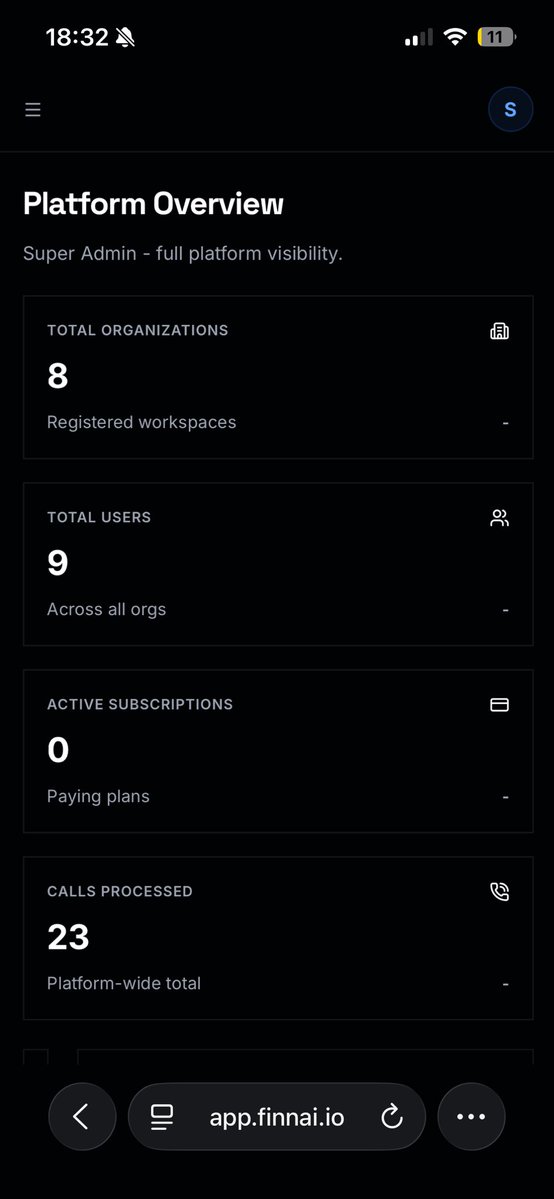
    Three days ago I launched FINN. Already: - 9 users - 23 sales calls processed - 8 organizations - 0 paid users… for now. And honestly, seeing people actually use something I built is pretty crazy. FINN is a real-time AI sales assistant that works directly inside your calls through a Chrome extension. It listens for what’s happening in the conversation and gives you the right insight at the right moment — without making you leave the call. If you’re a closer, try it: 👉 finnai.io

    @KevinFinnAI · Sales & outreach

  7. 0242

    A stealth dev recruiting platform with shield mode

    My coworker just became my very first user, and he has no clue I built the platform Dus ik ben de afgelopen paar weken aan een side project aan het coderen—een site om ontwikkelaars te werven die alle standaard flauwekul wegsnijdt en kijkt naar echte publieke GitHub-data en code-DNA. Ik heb een anonieme "Shield Mode" gebouwd zodat devs niet worden blootgesteld aan recruiters terwijl ze nog een dagbaan hebben. Anyway, ik moest testen of echte mensen het überhaupt zouden gebruiken, zonder dat ik mijn dekmantel op m'n werk opblies. Ik heb een paar dagen geleden op LinkedIn iets laagdrempeligs gepost, alsof ik zei: "check out deze coole tool die een vriend van me heeft gemaakt." De huidige cijfers zitten op zo'n 4 totale gebruikers en 16 bezoeken, maar de gemiddelde bezoekduur is om de één of andere reden ineens boven de 8 minuten geschoten—dat sloeg echt helemaal nergens op, zo van: wauw. Ik probeer dit door te trekken naar 25 geverifieerde profielen de volgende keer, zonder mijn dekmantel te slopen. Is er iemand anders die ooit iets heeft gebouwd dat zich richt op devs en een stealth launch heeft geflikt binnen z'n eigen netwerk? Hoe ben je door die koude start heen gekomen?

    u/Reasonable_Gas_8616 · Sales & outreach

  8. 0223

    Siteless: lead generation for web designers and agencies

    My SaaS is finally growing! I am a 16 year old and launched my small SaaS around 2-3 weeks ago. I haven’t really dabbled in much advertising (besides sharing around on Reddit) and it’s starting to take off. For context: I built Siteless, a lead generation tool that works for everyone from small web designers looking for clients, to agency owners that want to elevate their lead generation process. Recently it’s started taking off bringing in 380 users, most of which coming from a recent random surge in traffic in the past week. So far I have amassed 3 paying users! Totaling around 40 dollars in revenue! I’m starting to dedicate all of my free time to trying to scale this app to hopefully $100 a month soon. I’ll leave the link to Siteless down below in the comments for any of you that want to try it out.

    u/swiftstoriestt · Sales & outreach