How Much Do Indie Hackers Make? Reported MRR of 108 Indie Products (2026)
· 1,388 words
Every day, indie makers post their revenue on X and Reddit. We collect those posts on shipitfaststupid.com, and this page is what the numbers look like when you put them side by side.
The short answer
Out of 424 indie products in our catalog, 108 (about 1 in 4) shared a monthly recurring revenue (MRR) figure above zero. Among those 108:
- The median reported MRR is $1,000.
- The middle half earns between $100 and $10,000 a month.
- About half (57) report $1,000 or more, and about a quarter (28) report $10,000 or more.
- The most common exact figures are $1,000 and $10,000, tied at 8 products each.
- Almost nobody reports between $500 and $1,000. Only 5 products sit in that range.
The other 316 products either shared $0, shared other metrics (users, downloads, upvotes), or didn't share revenue at all.
How we got these numbers
- Source: public posts by makers on X (95 products) and Reddit (13 products), collected and categorized on shipitfaststupid.com. Every product links to the maker's original post.
- Self-reported, not audited. These are the numbers makers chose to share. Nobody here checked their Stripe.
- Cut-off: products listed as of October 2, 2026. Six unlisted entries were excluded.
- One number per product. When a product had both an MRR field and an MRR stat, we used the higher figure. Six products reported in euros; those figures are counted at face value, which doesn't change any range they fall in.
Keep the biggest bias in mind as you read: people post when they hit a milestone. That shapes everything below.
The distribution of reported MRR
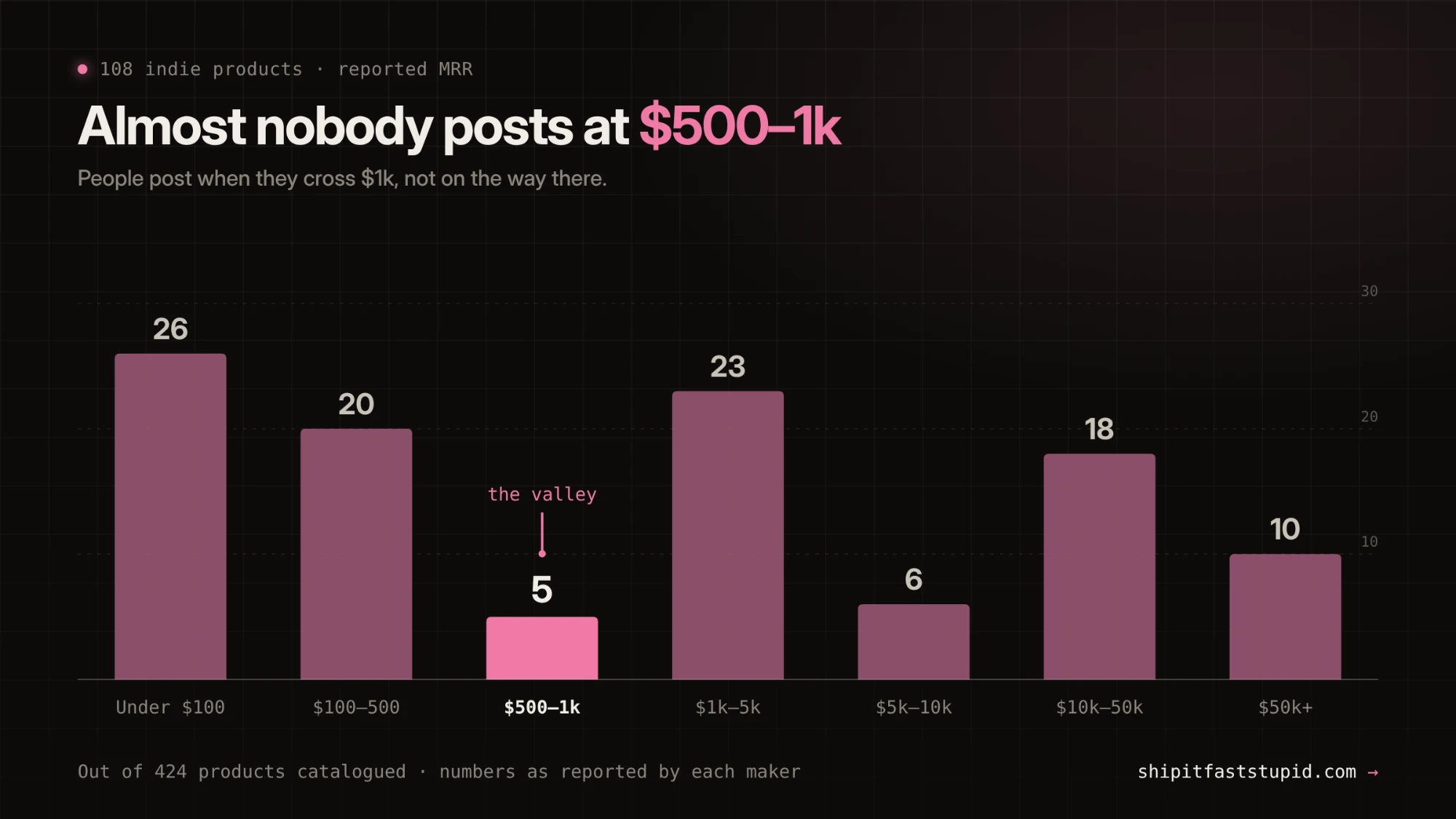
| MRR range | Products | Share of 108 |
|---|---|---|
| Under $100 | 26 | 24% |
| $100–500 | 20 | 19% |
| $500–1k | 5 | 5% |
| $1k–5k | 23 | 21% |
| $5k–10k | 6 | 6% |
| $10k–50k | 18 | 17% |
| $50k and up | 10 | 9% |
Two things stand out.
1. The "valley" at $500–1k. There's no business reason products would skip this range. Makers just don't post at $700 MRR; they post when they cross $1,000. The same happens again at $5k–10k (only 6 products), right below the next milestone people love to announce: $10k.
2. The crowd under $100. A quarter of the products that shared revenue are making under $100 a month. These are mostly early "first dollar" posts: the first subscriber, the first $15 month. They're worth reading because they show where almost everyone starts.
The most common MRR numbers
| Reported MRR | Products |
|---|---|
| $1,000 | 8 |
| $10,000 | 8 |
| $2,000 | 5 |
| $5,000 | 4 |
| $200 | 3 |
| $15 | 3 |
Round numbers win because round numbers are what people announce. "Just crossed $1k MRR" and "we hit $10k MRR" are the two most common revenue posts in the indie community, and the data shows it.
MRR by category
Medians for categories with at least 8 products that shared revenue:
| Category | Products | Median MRR |
|---|---|---|
| Sales and outreach | 10 | $5,000 |
| Marketing and growth | 10 | $4,400 |
| Developer tools | 21 | $1,000 |
| AI tools | 8 | $439 |
| Social media and creators | 8 | $388 |
| Productivity | 22 | $186 |
The pattern: tools that help businesses make money (sales, marketing) report higher MRR than consumer productivity apps. Productivity is the most crowded category in our whole catalog (85 products), yet its products that shared revenue have the lowest median here.
These samples are small, so treat this as a direction, not a law. Still, it matches what many makers say: businesses pay more, and more reliably, when a tool is tied to revenue.
How they got users
44 of the 108 makers said how they grew. Grouped by the channel they mentioned (some mentioned more than one):
| Growth channel mentioned | Products | Median MRR |
|---|---|---|
| SEO / content | 11 | $388 |
| TikTok, short video, slideshows | 10 | $628 |
| X / building in public / replies | 8 | $2,000 |
| Outbound, cold email, LinkedIn | 6 | $4,000 |
| Paid ads | 5 | $10,000 |
| Referrals / partnerships | 3 | $10,000 |
What this does and doesn't tell you:
- SEO and short-form video are the most talked-about channels, especially among newer products. They cost little to start, which is why early makers reach for them first.
- Outbound, paid ads and partnerships show up at higher MRR. That fits how products grow: once something works, makers can afford to buy growth or sell directly. It doesn't prove that ads will get you to $10k.
- The samples are tiny. Five products is an anecdote, not a trend. Read these as examples to study, below.
Time vs. revenue
53 makers gave a usable time frame for how long their product had been running.
- Products 3 months old or younger (32 of them): median $394 MRR.
- Products a year or older (9 of them): median $10,000 MRR.
Some reached $1k+ fast. GainFrame reported $2,507 MRR at 58 days, practicecelpip.ca $1,101 at 59 days, and Plate $3k about a month in. But the clearer story is the boring one: most products that reach $10k have been at it for a year or more.
Real examples at each stage
All figures as reported by the makers. Click through for each product's page and the original post.
$10,000+ MRR
- TrustMRR, a marketplace for buying and selling MRR businesses, by Marc Lou: $53k.
- ScreenshotOne, screenshots and clean Markdown of web pages for developers and AI agents, by Dmytro Krasun: $36k. Growth: paid ads and a hosted MCP server for AI agents.
- Gojiberry, turns competitors' LinkedIn engagement into leads, by Guillaume Bardet: $30k.
- Romeo, an SEO agent that audits a site every day, by Kourosh Ghaffari: $11k after about a year. Growth: SEO and GEO, with no blog posts.
- Reachkit, cold email software, by Quinten Kamphuis: $10k after almost two years. Growth: referrals first, then cold email.
$1,000–10,000 MRR
- OpenTweet, by Branko: $3.8k. Growth: SEO and AEO.
- Plate, a meal-planning app: $3k. Growth: two TikTok carousels a day.
- GainFrame, revenue analytics for makers: $2,507 at 58 days.
- practicecelpip.ca, practice tests for the CELPIP exam: $1,101 at 59 days.
- Taisly, analytics from first visit to payment: $1,000 after almost three years. Growth: Google, older SEO pages and translations, barely any paid ads.
Under $1,000 MRR
- Artur's subscription app: $551 in its first 27 days, from posting slideshow content every day.
- AutoTube, an AI YouTube video tool: $414 after six months. Growth: SEO and emailing users.
- postraid.com, a marketing-text generator: $388 in 13 days. Growth: SEO, articles, Reddit and landing-page updates.
What this means if you're building
- $1,000 MRR is the real middle. If you're there, you're at the median of makers willing to share revenue at all.
- Don't read the valley as a wall. $500–1k is empty because people don't post there, not because products can't get through it. If you're at $700, you're on the normal path.
- Business tools have the higher medians. If you're choosing what to build, sales and marketing tools reported more MRR than consumer productivity apps in this sample.
- Time matters more than launch day. Products a year or older report about 25 times the median MRR of products under three months old.
FAQ
How much do indie hackers make?
Among 108 indie products whose makers publicly shared MRR, the median was $1,000 per month. The middle half reported between $100 and $10,000. About 3 in 4 products in our wider catalog didn't share revenue at all, and many of those are likely earning little or nothing.
What is a good MRR for a micro SaaS?
In this data, $1,000 MRR puts you at the median of makers who share their numbers, and $10,000 puts you in roughly the top quarter. "Good" depends on your costs and goals, but those are the two milestones makers celebrate most.
How long does it take to reach $1,000 MRR?
It varies widely. Some products in our data reported $1k+ within about two months (GainFrame, practicecelpip.ca, Plate). But products under three months old had a median of $394, while products a year or older had a median of $10,000.
Which growth channel works best for indie products?
SEO/content and short-form video (TikTok, slideshows) were the most-mentioned channels. Outbound, paid ads and partnerships appeared more often at higher MRR, though the samples are small and those channels are often added after a product already works.
Are these numbers verified?
No. All figures are self-reported in public posts. We link every product to the maker's original post so you can judge for yourself.
Browse all 424 products and the numbers their makers shared at shipitfaststupid.com, or submit your own product. We update this study as the catalog grows.